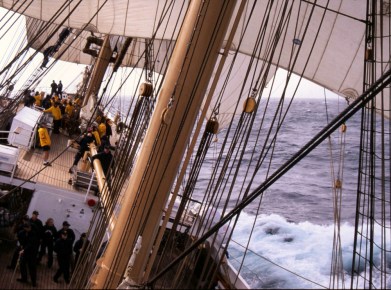
 The chow line was short tonight. The Eagle was heeled at fifteen degrees with deeper rolls. Those that were eating either propped one end of their food tray atop their milk glass or held it level with one hand, while eating with the other. There was not much conversation, only the occasional sound of crashing metal trays, silverware, and glass bowls, as they slid off the tables onto the tiled deck. It was like living in a house on a hillside, with floors built parallel to the ground—that moved—a never ending carnival ride.
I’m standing the mid-watch tonight with the ready boat crew. There are ten of us huddled on the port side of the open main deck, under the pin rail in the shelter of coiled lines. The night is dark, and heavy inky clouds blocked out any semblance of light; the sea and sky have merged. We are encapsulated in a black globe.
The ceaseless yawing, dipping, twisting, and rolling in heavy seas are wearing thin. The wind whistles through the rigging with surprising force, the pitch changing with each gust. The large mainsail snaps and pops with sound like a cracking whip. Block-and-tackles rattle, and chain-rigged clews clink and clank as they dance to the tune of the sea.
It’s not easy staying warm and dry, even with no rain. With every pitch into an oncoming wave, the flared bow of the Eagle coughs up a solid sheet of seawater. Now air conditioned by the howling wind, it builds into a man-chilling spray that blows the length of the entire deck. The smell of salt air fills our nostrils. Nobody escapes it.
The bad weather carries good news too. The barque loves it! Fully suited in her twenty-two sails, Eagle plows through the ocean with ease at fifteen knots as we sail closer to Santander, Spain. The weather demands an active watch. We are called to cant yards, secure loose gear, rig safety lines, and trim sails. Time passes quickly. Ding ding…ding ding…ding ding. The high pitched ring of the ship’s bell penetrates the howling wind. Six bells, our watch will be over in an hour. Two of us will roust out the relief at 0330.
Entering the berthing compartment is like stepping into deep inner space. A low ambient light from an unknown source creates an eerie scene. Hammocks dance in the dark, swaying together, as if an invisible orchestra was keeping time.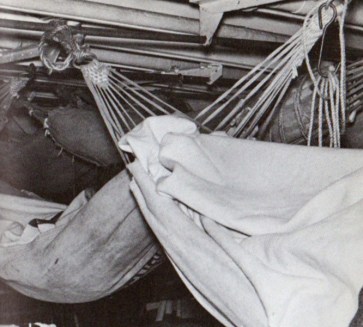 I brushed aside the dangling spider webs of hammock lashing cords as I picked my way through the cradled bodies, some strung high, others, low.
I squinted along the red beam from my flashlight looking for the stenciled names of the relief watch. The ship was rolling heavily. Actually, the hammocks were still, suspended in space. It was the ship that was swaying around them.
With no room for spreaders, the sleeping bodies were wrapped in curls of canvas, like caterpillars stretched between tree branches. Sounds and smells, made only by sleeping men, presented when I got close enough to shine my red light onto a face.
I found Arvie Pluntz. I tapped him on the shoulder and flickered my flashlight beam across his eyes a few times. “Good morning, Arvie, time for your watch. It’s 0340.”
“Yea, OK, OK.” He didn’t sound like he meant it.
“Come on, Arv. Don’t doze back off,” I said, in hushed tones. “Time for your watch.”
Arvie’s name is Richard V. Pluntz. When we were issued uniforms a year ago, he had set the stencil machine wrong. With no space between his initials— everything he owned read RV Pluntz. Hence, his nickname.
“I’m awake.” Arvie grabbed the overhead stay and swung his legs out of his cocoon. When his feet hit the deck, he stumbled, adjusting from the gimbaled comfort of the hammock to the pitch and roll of the deck.
“It’s pretty rough out there tonight, Arv.”
“OK, Thanks. Let me get my pants on and hitch up my can, and I’ll be right up.”
The can Arvie was going to hitch was an empty #2 spinach can that he got from the scullery. He had learned to cope with his constant sea-sickness last year on the short cruise. A couple of punched holes near the top rim, a strand of twine, rigged through his belt loops–he was set to go–his sea bucket always at the ready.
I never saw Arvie in bad humor. He stood every watch, did everything required, no complaints, and always with a big smile—but never without his bucket. He was smart and fun to be with. Richard V. Pluntz did not graduate with us. I can’t remember the reason he left the Academy, but maybe the thought of spending a major portion of his life with a #2 can tied to his belt had something to do with it.
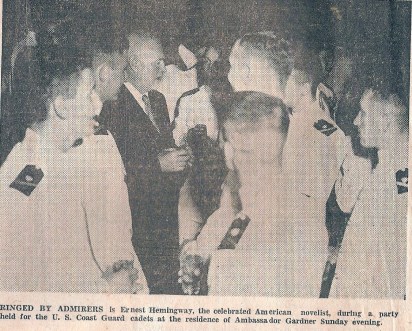 It did not take long to find him. His dark businessman’s suit and plain tie stood out behind the wall of dress whites that surrounded him like bars in a cage. An occasional pop of a newspaper photographer’s flash was a beacon to his entourage. Hemingway sported a neatly trimmed white beard that framed his square face into a block. He was a tall, powerfully built man with deep facial lines from years of outdoor adventures. He seemed to enjoy the animated conversation, drink in hand, asking about our summer on the Eagle.
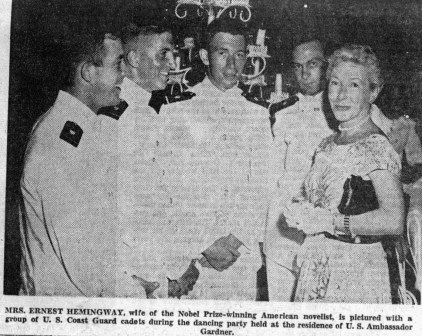 I joined a small group across the room to engage in pleasant conversation with Mary Hemingway. She was an attractive woman with short swept-back hair. She had a narrow face, and a small mouth that she pursed into a pretty smile. She was wearing a single pearl choker and carried a small black handbag under her arm. She cradled her drink in white gloved hands. The Havana Post photographer snapped a picture of four of us that appeared in the morning paper.
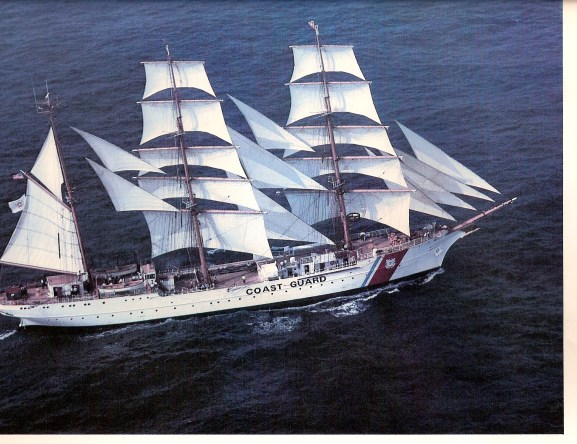 Some days bring you all the excitement you can stand. This was one of them. The Eagle’s visit to Hamilton, Bermuda was cut short by an oncoming hurricane.
 We had no safety harnesses in 1953.
 When I ended my last blog post on the Minnie V Rescue, the Coast Guard Cutter Cape Knox CG95312 was trying to save a fisherman from the stormy waters of the Chesapeake Bay. Criss Wolcott, who couldn’t swim, was too scared to let go of the keg he clung to and grab the lines we had thrown right over his arms. He was drifting down the port side back into the dark sea. The Chief was right. He was never going to let go of that keg. I needed to make another pass.
  Richard Marcott