The Colonel’s War is Not Over

Having skated by the Marine Colonel on the beach in the morning when I interrupted his amphibious war game, I was a bit concerned about returning to the beach in the afternoon to pick up our M-boat for transfer back to Ikeshima. I had barely turned off the main highway when I discovered “the war was not over, and I was still in the “battle zone.”

Fierce fighting was taking place in the scruffy growth near the roadside as the blue army made progress against the red defensive positions. I could hear gunshots including machine gun fire all around me.
Suddenly a marine jumped from the downhill side of my jeep and began running alongside firing blanks over the hood at an enemy he had apparently seen on the uphill side.

I was startled, but kept going at a slow pace down the curvy dirt road, the shooter running alongside, until the enemy jumped up on the hill, the two of them now firing at each other and hollering, “I got you.”
“No, man, I got you first.”
“The hell you did, you can’t use that jeep for cover; it’s not part of the exercise.”
“Is too. You’re dead, man!” At this point an officer umpire, I presumed because of the green arm band, leaped onto the road in front of me signaling everyone to a stop. I hit the brakes, and I think I may have even put my arms in the air a little, as the marines continued arguing.
The umpire quickly settled the argument.

In his senatorial voice and boring finality he announced, “Although the jeep is not officially part of the exercise, the blue invader showed marine initiative taking advantage of changing situations. The red defender is dead, the blue marine may continue.” Without another word, he waved me to continue.

About a quarter mile further, I came upon a roadblock with an armed sergeant stopping traffic and a machine gun nest set up at the side of the road behind a small sand bag bunker. I went through my story, figuring I had an advantage now. From the top of the hill, we could see our LCM coming back across the bay for the pickup, but the sergeant was not impressed. He knew navy vessels were grey and this black LCM approaching could very well be a third country vessel trying to pick up a spy! At his invitation, I accepted the armed guard who road with me while I followed the sergeant to battalion HQ.

Oh man! The battalion commander was my marine colonel friend from the beach. I felt better when he smiled and said, “So, you’re still around here causing trouble Lieutenant?”
“I hope not sir”
“I’ve heard that your LCM was on the way to pick you up, so I’m giving you a non-combat pass that will keep you out of trouble until you get out of here.” He was laughing.
“I’m really sorry for the trouble sir”, I apologized again, “we normally get message notice for this sort of thing. I don’t know what happened.
“Where you from Lieutenant?”
“Pennsylvania, Sir. Small town in Northwest, called Bradford.”
“You go to the Coast Guard Academy in New London?”
“Yes, Sir, class of ‘57.”
“You know, there was a lad about your vintage from my home town, Upper Sandusky Ohio, who went to the Coast Guard Academy, can’t remember his name.
I smiled and ventured a guess,“Would it be Tom Matteson, sir? How many other CGA grads around my age could there be from Upper Sandusky, Ohio? Tom always reminded us that, strangely, it was below Sandusky.
“By God, that is the name.”
“Yes, Sir, Tom’s a classmate. He’s in flight school now.
“Well, I’ll be damned.”
“Yes Sir.” Was that the correct response?
I never had a chance to tell that story to Tom until our 50th reunion at the Coast Guard Academy. He was pretty sure he knew the Colonel’s family. Tom, retired as a Rear Admiral and Superintendent of the Coast Guard Academy. He was later appointed as the Superintendent of the Merchant Marine Academy at Kings Point, NY.

The Colonel’s War

My beautiful picture
Loading the LCM for Kim Bay crossing

The lingering breeze from last night’s storm threatened to spill the fog from Kin Bay onto the station. Petty officer first class Smith rapped once on my office screen door.
“We’re good to go, sir. I just came from the beach. It’s damned foggy and the bay is still moving around a good bit, but I don’t think we’ll have a problem.”
“Thanks, Smith, I’ll be ready to roll in 10.” I had considered canceling the routine supply run, but the weather report called for clearing, and the wind was expected to die down, so getting back from the main Island of Okinawa in the afternoon was not going to be a problem. Smith was an experienced LCM coxswain, and I had great confidence in him.

The M boat was bobbing a bit, even in our protected cove, as I backed the jeep up the ramp and into position in front of our truck. Smith brought the ramp up, backed out expertly, made the pivot and headed out into the bay. The choppy waves pounded the flat ramp like a hammer trying to stop our forward motion. Visibility was less than a two hundred yards.
Half way into the seven mile crossing, an offshore breeze from the main island joined forces with the rising sun to lift the veil of fog. The coxswain called out, “Sir, we’ve got a problem here!”
I got out of the jeep, moved aft to climb the ladder leading to the cockpit. Before I got to the top I could clearly see “the problem.” We had blindly moved into the middle of a joint military exercise. We were surrounded by Amphibious Attack Transports, (APA’s), with their brood of LCVP’s and LCM’s circling them, like ducklings clinging to their mothers, their assault troops at the ready. The assault task force included a few Navy destroyer escorts and minesweepers.

Our uninvited and unexpected black Coast guard utility vessel was the ugly duckling in the middle of a gray Pacific Fleet Task Force! I envisioned Jeff Chandler, in the movie Away All Boats, on the wing of the command ship, all squinty eyed and strong jawed, preparing to give the signal to attack.

I grabbed the binoculars, and scanned the beach. A hazy picture of bleachers filled with military observers emerged in the thinning fog. There was at least one general’s flag flying along with two foreign ensigns. It was too late now.
“Smith, take us in slowly, get us unto the beach so we can get the hell out of the way. Then you go back to the station and I’ll call on land line to set up a pick-up time. Think you can hold it steady in this surf?”
“Yes, sir. It’s not too bad; we can off-load OK.”
The ramp splashed onto the beach, the stern rose and fell with the wavelets, but Smith held us steady with his skillful use of engines and rudder. A two foot wide coil of wire, slapping in the surf about 3 feet in front of our ramp, was not a welcome mat. I moved to the top of the ramp. From the front of the bleachers about 50 yards to the right I saw a Marine Corps lieutenant colonel, direct from central casting, a cigar stub in his mouth, sleeves rolled up. He was unperturbed by the sloshing water that soaked his pants half way up his calf. His combat boots cut angry deep divots in the wet sand. He stopped in front of our ramp. “Who the hell are you and where the hell did you come from?” He was steaming.
“Sir, I’m Lieutenant (JG) Marcott, CO of the Coast Guard Loran station on Ikeshima,” I saluted sharply and pointed toward the island. “Sir, I’m sorry to break up the exercises, but we received no message traffic about this. Clearly we would have never made our supply run today had I known.”
“I don’t give a damn about that,” he bellowed, “What I’m pissed about is we’ve held up this exercise for over an hour because the God damned Navy says it’s still too rough in here to land their boats!!” (His language throughout this exchange was a little more Marine-like.)
As soon as the words were out of my mouth, I knew I shouldn’t have said them. “Well sir, we’re pretty serious about our run—we’re after bread, milk and letters from home!”
I gulped then waited for what seemed an eternity. The colonel’s icy stare burned holes into my head, then suddenly he turned toward the beach and ordered, “Someone—anyone, cut this damned wire and clear a way for this man across the beach—Now! Then tell the Navy to get this damned show on the road!” Did I detect a slight smile?
I wasted no time getting across the beach, and up the road, passing units of the “red army” dug in, and waiting for the amphibious assault of the “blue army.” The Colonel’s war was about to begin.

Recruit Training Reform

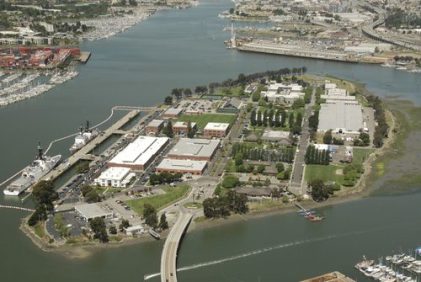
I was headed to the CG Training Center, Alameda (TRACEN) for an interview with the commanding officer, Captain Walter Curwen. The breeze felt good with the top down on my new Fiat 850 Spider.  I moved off Treasure Island into the early bridge traffic.

aerial2_coast_guard_island
Government Island: U.S. Coast Guard Training Center, Alameda, California

When I had appealed to my assignment officer a few days ago for a job at the TRACEN, he said. “You’ll have to meet with CAPT Curwen first. I can’t assign anyone as Training Officer without his approval.”

I met the Captain in his office. His natural smile and warm welcome made me feel good about him right away.
“Good morning, Captain, thank you for seeing me about your open training officer position.”
He gestured me to a chair, “Mr. Marcott, you’ll see in a minute why I felt it was important to meet with any officer being considered for this assignment.
“Captain, I think I have a good idea why,” I said. “I was Chief of the Training Branch in PTP before I came to the Resolute two years ago. Rear Admiral Scullion asked me in my exit interview how I felt about Alameda. I told him I was uncomfortable with their some of their methods.  I suspect you’re looking to make changes.”
The captain, relaxed back in his chair, and with a smile on his face he said “Good. Then let’s talk about recruit training.” In a few moments it was clear that we were on the same page.  The middle sixties were a challenge time for anyone, particularly the Armed Forces, trying to integrate young men into their workforce.

The country had grown weary of the Vietnam War. Young men of boot camp age had spent their formative years amidst youth protests movements, and anti-war militant’s open hostilities toward their parent’s middle class values. It was easy to embrace the norms of counterculture groups. They demanded individual freedom in all things, and flaunted their disdain for authority figures.
Of course, the Coast Guard had no magic source of recruits. Those who  reported to Alameda came from: troubled urban centers, pleasant suburbs, and quiet patches of remote countryside. The last sound heard by some was the gavel of a judge who told them their choice was the military or jail. Others heard their fathers telling them to get out and not bother to come back, or the cries of their mother who reluctantly gave up their youngest, but glad they would be saved from the gang warfare that threatened all her children.
On the other hand, many had enlisted to get the GI Bill that would pay for them to go to college later, others didn’t know what they wanted after high school, but thought the service was a good place to learn a trade. Some came because having received their masters degree, their student deferment had run out. They reasoned that joining the Coast Guard would be better than being drafted.
Every week seventy or more of these young men, the good, the bad, and the ugly, were dumped into the caldron of open bay living in double-deck bunks, and gang showers with yelling company commanders who made sure they could do nothing right.

To tackle the Training Officer job, my first priority was to spend time meeting with the key players: the company commanders, the assigned Navy Chaplains, and Dr. Dennis Short, a Psychiatrist, and a Commander in the Public Health Service Commissioned Officer Corps, and Chief of the TRACEN Medical Division. They did not have a history of always  working well together.
I learned two key things from these meetings: (1) Conditions had been much worse than I had suspected, and (2) With very few exceptions, the people directly on the firing line, the company commanders (CC’S,) were ready and willing to embrace change.
The meetings did wonders to improved relationship. By sharing their perspectives, the “good guys” began to trust each other and often devised a mutually agreed upon course of action. The CC’s were, at times, surprised with the “tough line” of the Chaplains. The Doctors professional observations and advice was welcomed by both.  In separate sessions with the CC’s, he taught them observations techniques, what behaviors to look for, and how to describe them in terms beyond “the kid just doesn’t have his shit together.”
I can’t fault anyone in the sixties who was trying to do right by their recruits and still meet the demands of their service. But, for whatever reason, the Marine Corps boot camp methods, which worked for the Marines, appealed to the Alameda Training Officer. It is my personal opinion, he had carried it well beyond the Marine Corps model, as though he was driven to out-Marine the Marines.
Poorly performing recruits were all dealt with as disciplinary problems. Placed in a separate X-Ray Company, they had undergone demanding physical fitness routines, marching drills, sleep disruptions, inane work details, and constant harassment. When the X-Ray company commander felt they were ready to “square away,” he returned them to regular training. I doubt if any recruit had left X-Ray company feeling better about himself or the Coast Guard.
We adopted a new a philosophy that gave every recruit the benefit of the doubt that he had volunteered, for whatever reason, to join our Coast Guard company and wanted to do well. If he was not performing, we looked for the cause and then dealt with him appropriately.
We retained X-Ray Company, for there were still some with serious discipline problems, but we did away with the insane climate. More importantly we established a Special Company, where a recruit needing  a more targeted remedial program which might include counseling or as we later found out was a major problem—remedial reading, he could get it.
I remember a recruit from a ranch in Montana. He had graduated from a small one-room school and the twenty friends and relatives who had attended his graduation were the most people he had ever seen in one place at one time. The Coast Guard Recruiter had driven him to the airport, and put him on a plane for San Francisco.
I can only imagine what he must have thought coming into SFO. He managed to get a bus to Alameda and worked his way to Government Island, only to be dumped into the mob scene with more weird people than he had ever seen in his life. He was not a discipline problem! He was overwhelmed!

We pulled him out of training for a week, provided a little adjustment counseling, and when he was ready, he performed well, graduated and moved on to the active fleet, a proud Seaman Apprentice.
The flagship of our reforms was a reading program run by a first class petty officer who held a masters degree in remedial reading. Joseph Streuffert developed and ran one of the most successful programs in the country,  and went on to his PhD, teaching in an eastern university.
Boot Camp in the sixties could have been the dream laboratory for sociologists and psychologists. But, I doubt they could have done a better job than the terrific Coast Guard petty officers who successfully turned these recruits around in eight weeks. After one week “down time” they turned around and did it again–year after year.

Holiday Exchange

In mid-July I was invited to share the O-bon Festival with a village family. A major holiday, this “Feast of the Dead,” is celebrated for eight days in Japan; on Okinawa it is limited to three. It marks a reunion with the spirits of the dead family members who return to the world of the living for a visit.


Ryukuan tomb
Wealthy Family tomb

The eve of the first day was a time to visit family tombs. Every family has one. It may be a simple small cave dug into the hillside, or an open jar of bones placed in a marked natural alcove in the side of the hill. The wealthy often built a concrete structure that might have been more expensive than their house. A standard design had a turtle-shaped dome and a small door similar to the tunnel entrance into the more familiar Eskimo Igloo.

Copy of Bone Urn
Poor family tomb

In a different era, it was the job of the youngest unmarried woman of the family to enter the tomb and cleanse any remaining flesh off the bones of departed family members. The bones were then placed in decorative vases in the rear of the tomb, cleansing the spirits for their visit to the earthly world and making room for more family members. Cremation has begun to eliminate this ancient practice, although I have heard that some traditional families in rural areas might still practice this.  Ikeshima? I don’t know.

I arrived in the afternoon of first day of the feast, when the family gathers for a meal in their shrine room (chashitsu, a small formal tea room) in their home. My hostess welcomed me with gracious bows as she pointed for me to enter. She wore a beautiful kimono of colorfully patterned silk, her hair meticulously piled high on her head, held there by several large combs. A broad sash, obi, circled her waist several times. I bowed in return, thanked her, “Domo arigato gozaismasu.” She smiled at my more formal “thank you very much,” not just “thanks.”
I placed my white bucks (I was in tropical white uniform) alongside the row of getas (Japanese wooden sandals) on the single step leading into the raised chashitsu. The room was small, 9ft x 9ft, with no furniture except the low table in the middle of the room. The purity of the atmosphere was enhanced by the pale off-white light that filtered through the rice paper sliding doors, and the strong odor of incense that burned in a small dish in the Tokonoma.

SONY DSC
Illustration only of Tokonoma. this is not a picture of the one in my home visit.

The Tokonoma, a shrine-like recess in the wall, was decorated with a single vase with long pussy willow-like branches that stretched high above its rim on one side next to the burning incense. A  vertical scroll with large hand-painted Japanese Kanja characters that said “something suitable for the season,” hung on the back wall. The Tokonoma was unquestionably the focal point of the room.
I was seated at one end of the table facing the shrine. Four family members were seated, two on each side of the table. The guest of honor’s place was opposite me where he would be framed by the Takonoma at his back. Others, when looking at him, would then see him as if he were included in a three dimensional religious scene. In this case, of course, the seat remained empty, having been reserved for the expected ancestral spirit. There was a small dish of cut fruit set at each place—including the empty seat of honor.
The ladies spoke in subdued tones, half Japanese, half English, trying to explain key points of the holiday. I had a basic idea what to expect, but when the moment came, I confess that I entered a whole new dimension.
One of the women at the other end of the table suddenly thrust her arms out over the table, palms down, and let out a loud SSSSHHHH. Everything stopped. She continued the SSSHHH-ssshhh gradually lowering the volume as well as her hands until they were touching the table.

There was a long pause, and then she whispered in a barely audible voice, “Ghosto come.”

When I saw the intensity on the face of the others as they directed their attention toward the empty seat, I just knew that all of them felt a new presence. For a moment, I wasn’t sure about me! The rising hairs on my arms sent me into a physical shudder.
Part of me wanted to get out of there, part of me wanted to stay. Low level conversation in Japanese continued for a while as we ate the fruit on our plates. I was no longer involved. I found myself thinking, “Are they talking about the spirit— or talking to him?”
After an eternity of fifteen minutes or so, the ceremony was over. We thanked each other for the opportunity to share the O-Bon, and I returned to the station. The religious rapture I saw on the faces of the Japanese ladies when the spirits arrived reminded me of the look on elderly Italian ladies kneeling, reciting the rosary, in the wooden pews of St. Bernard’s church at home. Though each communed with a very different Great-Spirit, they both seemed at peace in their own world.

The second day of O-Bon was more like a family reunion, where they exchanged gifts and payed homage to their ancestors. The final day was a time for gay festivities, shows, and dances that lead up to the final send-off. Sugar canes were cut to length and placed outside the tomb as walking sticks to assist their ancestors in their return journey to the land-of-the-spirits.

In return for the wonderful O-Bon experience, I invited a small group to share an American holiday. I always considered Halloween and Thanksgiving as uniquely American, but I ruled out Halloween as too close to O-Bon. They might think we were “making fun of it.” So, the Mayor’s party of six joined us for our “Coast Guard Loran Station Thanksgiving Holiday Dinner.” The four women were dressed for a special occasion in their colorful formal kimonos. The men wore suits and ties.
Our skilled cook took pleasure in preparing a traditional meal. We had a huge carved turkey, ham, mashed potatoes, dressing, the whole works. While the mess hall lacked traditional decorations beyond a centerpiece of fruits and nuts, the aroma of roasting turkey and pumpkin pies stirred hints of homesickness in many of our young crewmen who were thousands of miles from home.

Our guests joined our key petty officers and me at a head table. After the round of normal bows, they shook hands, and then giggled with their fingers appropriately covering their mouth, lest they offend.
The women looked nervous as they watched and copied the mayor’s every move. They all seemed overwhelmed with the abundance of food, and confused by the complications of using knives and forks.

Everyone was intrigued. They all enjoyed the taste of turkey, ham, and all the veggies, but they loved the pumpkin pie. Their animated expressions and rapid Japanese chatter told me they understood and enjoyed our house-boy Seiji’s rendition of the “Story of American Thanksgiving.”
When the ritual cigars were offered at the end of the meal, the women, seeing the Mayor take one, did the same. By the time I noticed, they had already followed the mayor… and lit up. I didn’t want to embarrass them, so I said nothing. After three or four puffs, lots of smoke, and a few coughs, one lady ceremoniously placed her cigar in an ashtray, the others followed. They very graciously took it all in stride. It was a great day for everyone.