I don’t know when it happened—that brotherhood thing—that  unbreakable bond that tied us together for a life time. It was not foreknown. It just happened. It engulfed us with the subtly of a smell on the wind or a scent from afar that gradually molded our pool of survivors into a band of brothers. I place my awakening at the end of our first long cruise.
Like many of the windjammers of old, coming out of Copenhagen the Eagle needed the favorable easterly winds of the northern route home. We passed north of Scotland and just south of Iceland. Despite the calendar showing we were in mid-summer, it was cold at sixty-three degrees north latitude, and often overcast. When it was clear, h owever, we had a lot of time for navigation sights. We had a good horizon and the stars were out from sunset until sunrise—the land of the midnight sun.

The navigational chart posted on the bulkhead of the forward mess deck became a center of attention. When the cadet navigator plotted our position on 24 July, we still had twenty-three hundred miles to go.
The days at sea had long since settled into a repetitive routine. We all felt the draw of our fourth, and best, liberty port—home. We did have diversions. Movies again became popular: Cattle Town, Lili, Gentlemen Prefer Blonds, and the all hands favorite, Salome.
Coast Guard Day is August 4th. It is celebrated at every Coast Guard unit, on land or at sea. We enjoyed a holiday routine. We had goofy pie-eating contests, skits, and a rag-tag cadet band whose uniforms of Bermuda shorts and wool watch sweaters were fitting for an open deck picnic in the north Atlantic. They wore blue uniform cap covers, without the cap frame, tilted to resemble a French beret. A brass piece, a bass drum, a guitar or two, and a leader wielding a toilet plunger baton—The Horstvessel Furslugeners—were great fun.
The star attraction of the afternoon was Papa Santos’ Band. A popular first class petty officer cook, Santos led a string-band formed from his Hawaiian, Samoan, and Filipino cooks and stewards. They were good musicians who played snare drums, ukuleles, and guitars. Papa always stole the show with his home-made bass, an upside down metal garbage can with a tall wooden stick mounted on the side. Two strings ran through the drum and stretched over the carved top of the stick. The strings had wood toggles on the end. When Papa manipulated them by twisting and changing the tension, multiple tones boomed from the garbage can. He played a mean bass, in his black derby, with a great sense of rhythm and showmanship.
Finally on the 12th of August, New London Ledge Light hove into view. After a pause for a neat harbor furl, we stepped the mast so we could get under the bridge. In a traditional gesture, we gathered our oldest black uniform shoes, the ones worn only in the engine room–steamers, and brought them topside to the rail. Knowing these battered and scarred shoes would never be wearable in uniform again, we threw them at the base of the raised railroad bridge in tribute to the end of a great cruise.
Hundreds of shoes filled the air in a black arc that splashed like spattered pebbles at the base of the bridge and sank to the bottom of the Thames River. The growing mound of cadet shoes from years past made the strangest fish haven on the east coast.
We had logged 10,339 miles in seventy-six days. Since Copenhagen, we had been at sea for twenty-six. We were ready for home leave.
For over a year we had lived, worked, studied, and played together nearly every day. We had been annealed by the fire of swab indoctrination and shared experiences. We stood tests of self-discipline, physical stamina, commitment to service, and capacity for teamwork. We had been molded into a strong family with shared values of honor and duty, and we held a deep respect for the U. S. Coast Guard.
Our entering class of one hundred ninety-eight civilians was now ninety-nine clinging cadet survivors—the brotherhood of 1957. We missed those who were no longer with us, and cheered for all who continued to march.
The bonds strengthened after graduation. We worked for the same company. We married sisters, cousins, Conn College coeds, and New London girls. We shared duty stations, and watched each other’s families grow. Jack Irwin felt the pull of the brotherhood. He left our class in our swab year. He returned, teary eyed, when he was finally able to make it back to a class reunion—our fiftieth.
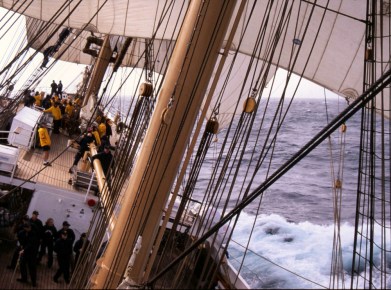 The chow line was short tonight. The Eagle was heeled at fifteen degrees with deeper rolls. Those that were eating either propped one end of their food tray atop their milk glass or held it level with one hand, while eating with the other. There was not much conversation, only the occasional sound of crashing metal trays, silverware, and glass bowls, as they slid off the tables onto the tiled deck. It was like living in a house on a hillside, with floors built parallel to the ground—that moved—a never ending carnival ride.
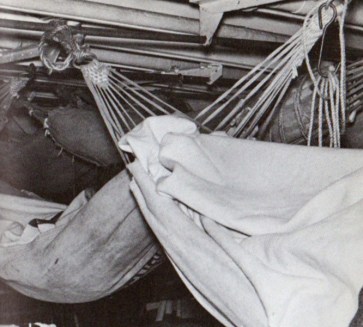 I brushed aside the dangling spider webs of hammock lashing cords as I picked my way through the cradled bodies, some strung high, others, low.
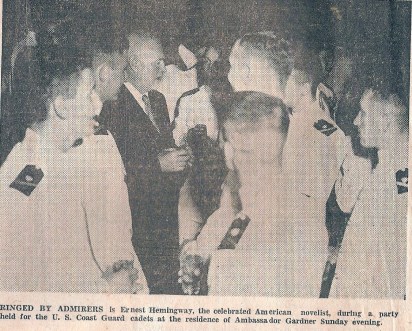 It did not take long to find him. His dark businessman’s suit and plain tie stood out behind the wall of dress whites that surrounded him like bars in a cage. An occasional pop of a newspaper photographer’s flash was a beacon to his entourage. Hemingway sported a neatly trimmed white beard that framed his square face into a block. He was a tall, powerfully built man with deep facial lines from years of outdoor adventures. He seemed to enjoy the animated conversation, drink in hand, asking about our summer on the Eagle.
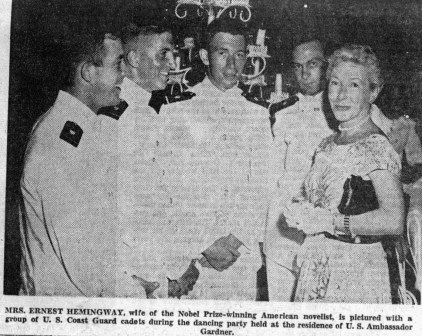 I joined a small group across the room to engage in pleasant conversation with Mary Hemingway. She was an attractive woman with short swept-back hair. She had a narrow face, and a small mouth that she pursed into a pretty smile. She was wearing a single pearl choker and carried a small black handbag under her arm. She cradled her drink in white gloved hands. The Havana Post photographer snapped a picture of four of us that appeared in the morning paper.
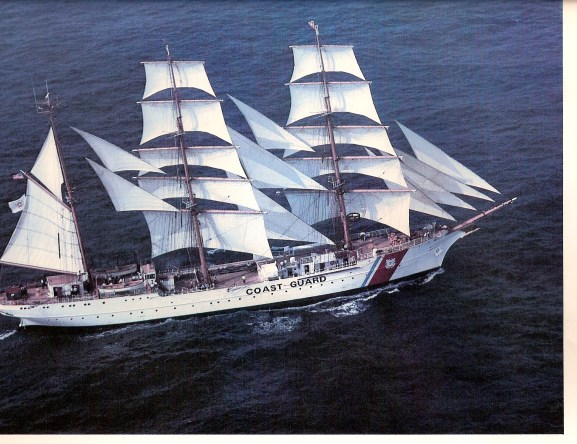 Some days bring you all the excitement you can stand. This was one of them. The Eagle’s visit to Hamilton, Bermuda was cut short by an oncoming hurricane.
 We had no safety harnesses in 1953.
 Richard Marcott