The Book is Here

Blank bookcover with clipping path Now Available in Paperback and Kindle at Amazon.com 

As those who have been following chapter excerpts on my blog know, these memoirs covers my Coast Guard Career from Academy days to retirement. I am proud to share these back of the book blurbs.

“In my experience, the best way to learn something is to find a teacher who blends historical facts with the art of story-telling. Dick Marcott proves he is the master in “The View from the Rigging”. Those of us who paralleled his professional life, can smile often and remember our own experiences as Dick reviews his Coast Guard career. Others are introduced to the extraordinary blend of the professional and personal commitment of both the service member and the family of those who dedicate themselves to public service in the uniform of their country. It’s a story told well and highlighted with very real moments of serious accomplishment at work and at home. We should all be so fortunate to have such stories to tell our grandchildren.”

James M. Loy ADM, U. S. Coast Guard (Retired) Commandant, 1998-2002

 “I never cease to be amazed at what I learn from Captain Marcott’s memoirs of a fascinating life I never knew existed. The stories are a tribute to his service that he sells with beautiful detail, humor, and pathos.

Dani Weber, Asst. Prof. of English, SUNY Sullivan

“If you’ve ever been to sea, you’ll enjoy my friend Dick Marcott’s tales of Coast Guard Duty. If you haven’t, this book might count as your first deployment.”

David Poyer, author of TIPPING POINT and ONSLAUGHT

The Colonel’s War

My beautiful picture
Loading the LCM for Kim Bay crossing

The lingering breeze from last night’s storm threatened to spill the fog from Kin Bay onto the station. Petty officer first class Smith rapped once on my office screen door.
“We’re good to go, sir. I just came from the beach. It’s damned foggy and the bay is still moving around a good bit, but I don’t think we’ll have a problem.”
“Thanks, Smith, I’ll be ready to roll in 10.” I had considered canceling the routine supply run, but the weather report called for clearing, and the wind was expected to die down, so getting back from the main Island of Okinawa in the afternoon was not going to be a problem. Smith was an experienced LCM coxswain, and I had great confidence in him.

The M boat was bobbing a bit, even in our protected cove, as I backed the jeep up the ramp and into position in front of our truck. Smith brought the ramp up, backed out expertly, made the pivot and headed out into the bay. The choppy waves pounded the flat ramp like a hammer trying to stop our forward motion. Visibility was less than a two hundred yards.
Half way into the seven mile crossing, an offshore breeze from the main island joined forces with the rising sun to lift the veil of fog. The coxswain called out, “Sir, we’ve got a problem here!”
I got out of the jeep, moved aft to climb the ladder leading to the cockpit. Before I got to the top I could clearly see “the problem.” We had blindly moved into the middle of a joint military exercise. We were surrounded by Amphibious Attack Transports, (APA’s), with their brood of LCVP’s and LCM’s circling them, like ducklings clinging to their mothers, their assault troops at the ready. The assault task force included a few Navy destroyer escorts and minesweepers.

Our uninvited and unexpected black Coast guard utility vessel was the ugly duckling in the middle of a gray Pacific Fleet Task Force! I envisioned Jeff Chandler, in the movie Away All Boats, on the wing of the command ship, all squinty eyed and strong jawed, preparing to give the signal to attack.

I grabbed the binoculars, and scanned the beach. A hazy picture of bleachers filled with military observers emerged in the thinning fog. There was at least one general’s flag flying along with two foreign ensigns. It was too late now.
“Smith, take us in slowly, get us unto the beach so we can get the hell out of the way. Then you go back to the station and I’ll call on land line to set up a pick-up time. Think you can hold it steady in this surf?”
“Yes, sir. It’s not too bad; we can off-load OK.”
The ramp splashed onto the beach, the stern rose and fell with the wavelets, but Smith held us steady with his skillful use of engines and rudder. A two foot wide coil of wire, slapping in the surf about 3 feet in front of our ramp, was not a welcome mat. I moved to the top of the ramp. From the front of the bleachers about 50 yards to the right I saw a Marine Corps lieutenant colonel, direct from central casting, a cigar stub in his mouth, sleeves rolled up. He was unperturbed by the sloshing water that soaked his pants half way up his calf. His combat boots cut angry deep divots in the wet sand. He stopped in front of our ramp. “Who the hell are you and where the hell did you come from?” He was steaming.
“Sir, I’m Lieutenant (JG) Marcott, CO of the Coast Guard Loran station on Ikeshima,” I saluted sharply and pointed toward the island. “Sir, I’m sorry to break up the exercises, but we received no message traffic about this. Clearly we would have never made our supply run today had I known.”
“I don’t give a damn about that,” he bellowed, “What I’m pissed about is we’ve held up this exercise for over an hour because the God damned Navy says it’s still too rough in here to land their boats!!” (His language throughout this exchange was a little more Marine-like.)
As soon as the words were out of my mouth, I knew I shouldn’t have said them. “Well sir, we’re pretty serious about our run—we’re after bread, milk and letters from home!”
I gulped then waited for what seemed an eternity. The colonel’s icy stare burned holes into my head, then suddenly he turned toward the beach and ordered, “Someone—anyone, cut this damned wire and clear a way for this man across the beach—Now! Then tell the Navy to get this damned show on the road!” Did I detect a slight smile?
I wasted no time getting across the beach, and up the road, passing units of the “red army” dug in, and waiting for the amphibious assault of the “blue army.” The Colonel’s war was about to begin.

A Rough Night Crossing the Atlantic

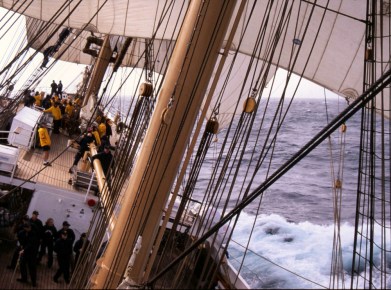
EagleLookingForward2The chow line was short tonight. The Eagle was heeled at fifteen degrees with deeper rolls. Those that were eating either propped one end of their food tray atop their milk glass or held it level with one hand, while eating with the other. There was not much conversation, only the occasional sound of crashing metal trays, silverware, and glass bowls, as they slid off the tables onto the tiled deck. It was like living in a house on a hillside, with floors built parallel to the ground—that moved—a never ending carnival ride.

I’m standing the mid-watch tonight with the ready boat crew. There are ten of us huddled on the port side of the open main deck, under the pin rail in the shelter of coiled lines. The night is dark, and heavy inky clouds blocked out any semblance of light; the sea and sky have merged. We are encapsulated in a black globe.

The ceaseless yawing, dipping, twisting, and rolling in heavy seas are wearing thin. The wind whistles through the rigging with surprising force, the pitch changing with each gust. The large mainsail snaps and pops with sound like a cracking whip. Block-and-tackles rattle, and chain-rigged clews clink and clank as they dance to the tune of the sea.
It’s not easy staying warm and dry, even with no rain. With every pitch into an oncoming wave, the flared bow of the Eagle coughs up a solid sheet of seawater. Now air conditioned by the howling wind, it builds into a man-chilling spray that blows the length of the entire deck. The smell of salt air fills our nostrils. Nobody escapes it.

The bad weather carries good news too. The barque loves it! Fully suited in her twenty-two sails, Eagle plows through the ocean with ease at fifteen knots as we sail  closer to Santander, Spain. The weather demands an active watch. We are called to cant yards, secure loose gear, rig safety lines, and trim sails. Time passes quickly. Ding ding…ding ding…ding ding. The high pitched ring of the ship’s bell penetrates the howling wind. Six bells, our watch will be over in an hour. Two of us will roust out the relief at 0330.

Entering the berthing compartment is like stepping into deep inner space. A low ambient light from an unknown source creates an eerie scene. Hammocks dance in the dark, swaying together, as if an invisible orchestra was keeping time.Hammocks I brushed aside the dangling spider webs of hammock lashing cords as I picked my way through the cradled bodies, some strung high, others, low.
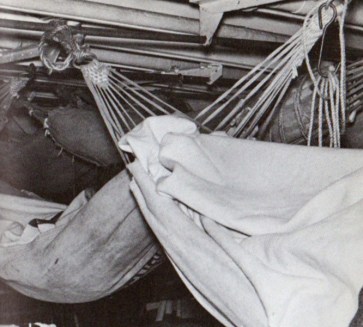
I squinted along the red beam from my flashlight looking for the stenciled names of the relief watch. The ship was rolling heavily. Actually, the hammocks were still, suspended in space. It was the ship that was swaying around them.

With no room for spreaders, the sleeping bodies were wrapped in curls of canvas, like caterpillars stretched between tree branches. Sounds and smells, made only by sleeping men, presented when I got close enough to shine my red light onto a face.
I found Arvie Pluntz. I tapped him on the shoulder and flickered my flashlight beam across his eyes a few times. “Good morning, Arvie, time for your watch. It’s 0340.”
“Yea, OK, OK.” He didn’t sound like he meant it.
“Come on, Arv. Don’t doze back off,” I said, in hushed tones. “Time for your watch.”
Arvie’s name is Richard V. Pluntz. When we were issued uniforms a year ago, he had set the stencil machine wrong. With no space between his initials— everything he owned read RV Pluntz. Hence, his nickname.
“I’m awake.” Arvie grabbed the overhead stay and swung his legs out of his cocoon. When his feet hit the deck, he stumbled, adjusting from the gimbaled comfort of the hammock to the pitch and roll of the deck.
“It’s pretty rough out there tonight, Arv.”
“OK, Thanks. Let me get my pants on and hitch up my can, and I’ll be right up.”

The can Arvie was going to hitch was an empty #2 spinach can that he got from the scullery. He had learned to cope with his constant sea-sickness last year on the short cruise. A couple of punched holes near the top rim, a strand of twine, rigged through his belt loops–he was set to go–his sea bucket always at the ready.

I never saw Arvie in bad humor. He stood every watch, did everything required, no complaints, and always with a big smile—but never without his bucket. He was smart and fun to be with. Richard V. Pluntz did not graduate with us. I can’t remember the reason he left the Academy, but maybe the thought of spending a major portion of his life with a #2 can tied to his belt had something to do with it.

The First Thanksgiving

THE FIRST THANKSGIVING

At noon I joined the mass of uniformed cadets in a dash to the New London train station. I turned from the platform into the first car…to join what seemed like a million college students from every school north of New London. The railroad always claimed they put on extra cars for Thanksgiving. I never believed it.

All I knew was that I made the entire trip standing, suitcase on the deck, squeezed between my ankles, fighting the swaying train with one hand on overhead rack. The air was close and reeked of sweat and stale cigarette breath. The crowd, already worn and hot, had randomly flung their coats, hats, and scarves all over the car.

The coeds, while still chatty, didn’t smile, their beauty lessened by their weary trip. My flesh never touched fewer than three other people at the same time during the two-hour ordeal to New York.

At Penn Station, the car doors opened and before the wheels stopped screeching in a shower of sparks, and a herd of twenty-somethings, like fire ants scattering from their mound, stampeded into the oblivion of New York City. I boarded a shuttle bus to Rockefeller Center and the Erie Railroad office where I would begin my lonely overnight trip to Salamanca, NY. Continue reading “The First Thanksgiving”