The tall Russian captain, his four gold stripes tarnished by years of salt air, smiled at our Coast Guard boarding party. I was on a factory vessel in the middle of the Bering Sea. It was my thirty fourth birthday, July 20th 1969. The four of us had just made the long climb up the pilot ladder, and stepped through the bulwark of the four-hundred-foot converted cargo vessel. Now we stood before the Captain and two civilian men who greeted us. The Captain smiled, saluted, then shook hands all around, stood back then pronounced, “Gentlemen. Congratulations! Your man has landed safely on the moon.”
This was our first news of the success of the U.S. Appolo Eleven Mission.
From a Russian!
The USCG Cutter Resolute was mid-tour on a sixty-day Alaskan fisheries patrol. We knew this one would be different. The U.S. may have entered an official period of détante with Russia, but that didn’t mean we were all that trusting. We suspected that Russian factory vessels, with far beyond typical antenna arrays, were engaged in electronic eavesdropping. Their gear obviously beat the fickle communication Gods of the Bering Sea; we had received nothing.
Sid Morgan, an agent of the Alaskan Department of Fish and Game, (our Fin and Feathers Guy), was part of the boarding party. We counted on him for the details of the treaties and, above all, identifying the various species.
The captain introduced himself as the ship’s master and the heavy-set civilian next to him as the fleet commander. The thin man in the background was not introduced, but also never went away. I presumed he was the ever present party representative that I had been briefed about.
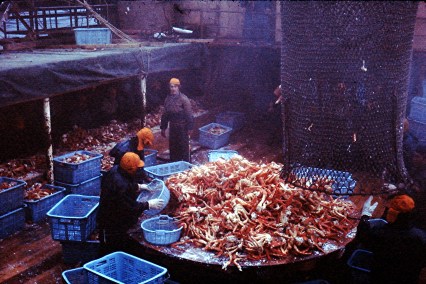
The open deck amidships was piled high with squirming Red Alaskan King Crab.
Their smell filled the air. We watched the ship’s crane swing overhead, the operator expertly lowering a large net to the catcher boat alongside. It soon reappeared, dumping a new load of live crabs atop the pile already struggling to regain their freedom. The purple and white crabs, which can reach twenty-five to thirty pounds, with a leg spread of as much as six feet, their shells encrusted with sharp spiny bumps, tumbled over each other like bizarre outer space creatures playing king of the mountain.
We observed the sorting operation for a while then the Captain gestured us toward a door inviting us into a narrow, dimly lit passageway that led to the wardroom. As a crew member held the heavy steel door, I noticed that Sid, just before he stepped over the shin-busting threshold, caught a glance back at the crab pile. He made mental notes of the size, species, and estimated numbers of the catch.
As we snaked out way to the wardroom, the Captain suddenly took my elbow and quietly said, “Come with me, please.” The rest of the party moved on while I turned to follow the Captain down a side passageway and up to the next deck. Stopping at a beautiful mahogany door with a polished brass name plate, he turned and said, “Please step into my cabin.”
My mind struggling for a scenario, I stepped inside. He followed and closed the door. Before I could say anything he pointed for me to sit in a small leather chair at the side of his desk and, in perfect English, he asked, “Do you own a car?”
“Do I own a car?” I had no idea where this was going.
“Yes, do you have an automobile?
“Yes, Captain, I do.”
“What kind?”
“A Toyota Corona.”
The Captain leaped out his chair, a huge grin on his face, extended his hand to shake mine, pumping it vigorously. “So do I!” I got the feeling he now saw us as some sort of kindred spirits. He sat down and leaned back in his chair.
“How long did you wait?” He steepled his hands, tapping his fingertips in anticipation of my answer. I must have looked confused. I had no idea what he meant. “You know. How long did you have to wait to get your car?”
“I’m sorry Captain. I don’t understand.”
“Well, in my country, as Captain of a fleet factory vessel, I am highly ranked. I got my new car after waiting only three months. How long did you wait?”
“Captain, in my country anyone who wants to buy a car makes a trip a car store. There are usually several in a row on the same street. When I bought mine, I knew I wanted a Toyota, test drove a few models, decided, then bargained for the best price. I drove the car home the same afternoon.” From the look on his face I feared I had embarrassed him. Damn!
He said nothing for awhile, then, “I like the U.S. Coast Guard. They are not like the Navy or Army. You and I are just men who go to sea.” After a slight pause, he added, “ I don’t like our Army or Navy either.” Before I could recover, he placed both palms flat on his desk, pushed out of his seat and pointed to his cabin door.
“We should probably be joining the others in the wardroom.” To this day, I imagine an old Russian sea captain sitting around a fire, stoking his pipe, downing a vodka, dramatizing this same event to his grandchildren, “….yes, that’s what that crazy American tried to get me to believe—he buys his cars in one day!”
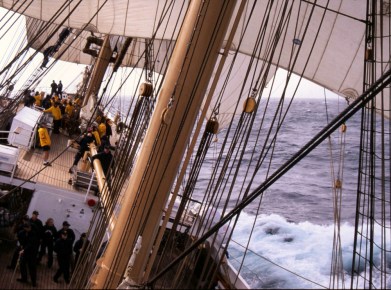 The chow line was short tonight. The Eagle was heeled at fifteen degrees with deeper rolls. Those that were eating either propped one end of their food tray atop their milk glass or held it level with one hand, while eating with the other. There was not much conversation, only the occasional sound of crashing metal trays, silverware, and glass bowls, as they slid off the tables onto the tiled deck. It was like living in a house on a hillside, with floors built parallel to the ground—that moved—a never ending carnival ride.
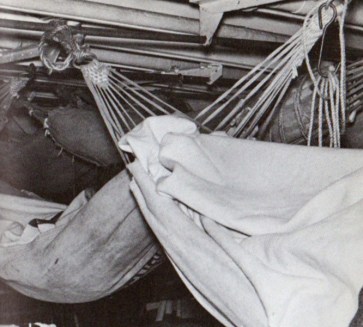 I brushed aside the dangling spider webs of hammock lashing cords as I picked my way through the cradled bodies, some strung high, others, low.
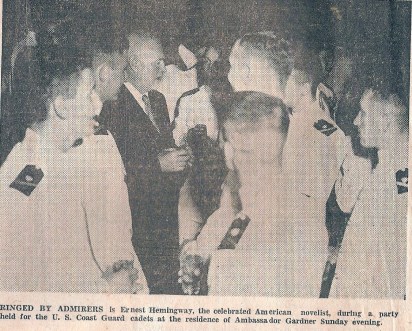 It did not take long to find him. His dark businessman’s suit and plain tie stood out behind the wall of dress whites that surrounded him like bars in a cage. An occasional pop of a newspaper photographer’s flash was a beacon to his entourage. Hemingway sported a neatly trimmed white beard that framed his square face into a block. He was a tall, powerfully built man with deep facial lines from years of outdoor adventures. He seemed to enjoy the animated conversation, drink in hand, asking about our summer on the Eagle.
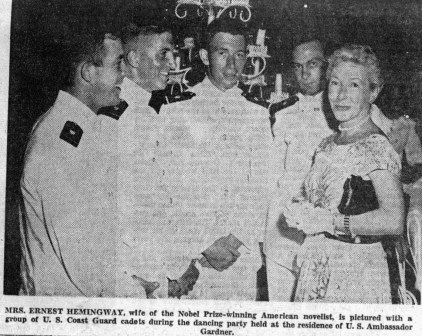 I joined a small group across the room to engage in pleasant conversation with Mary Hemingway. She was an attractive woman with short swept-back hair. She had a narrow face, and a small mouth that she pursed into a pretty smile. She was wearing a single pearl choker and carried a small black handbag under her arm. She cradled her drink in white gloved hands. The Havana Post photographer snapped a picture of four of us that appeared in the morning paper.
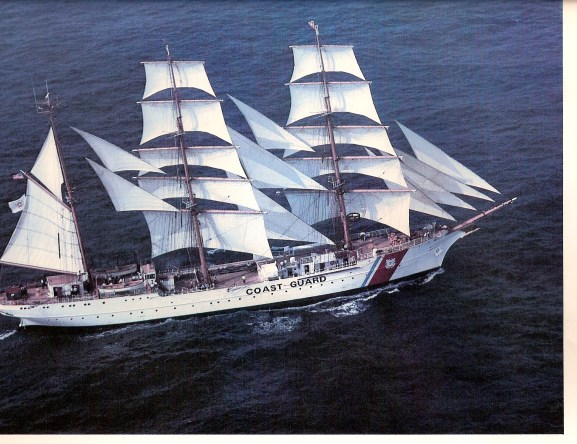 Some days bring you all the excitement you can stand. This was one of them. The Eagle’s visit to Hamilton, Bermuda was cut short by an oncoming hurricane.
 We had no safety harnesses in 1953.
 Richard Marcott